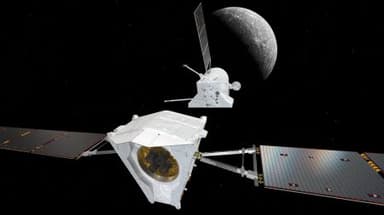
The joint space exploration mission undertaken by Europe and Japan reached a major milestone as its probes entered orbit around Mercury after a long interplanetary transit. On November 22, 2026, the European Space Agency (ESA) announced that the spacecraft had successfully achieved orbital insertion around the solar system's innermost planet. The accomplishment culminates an eight-year journey that began with the mission's launch in 2018.
Established Facts Confirmed by Outlets
All three outlets—Nature News, 한겨레, and NHK 科学・文化—confirm that the joint European and Japanese mission successfully arrived at Mercury after an eight-year flight. According to NHK 科学・文化, the European Space Agency announced that the Japanese probe named "Mio" was inserted into an orbit surrounding Mercury while connected with its European counterpart. NHK 科学・文化 also notes that the spacecraft had been traveling through space toward the planet closest to the Sun since its launch eight years prior in 2018.
Nature News explicitly identifies the mission as "BepiColombo" and reports that European and Japanese probes will follow different trajectory paths around Mercury to study the planet's surface alongside its surrounding environment. The arrival marks the end of a complex interplanetary navigation sequence designed to slow down the spacecraft sufficiently against the gravitational pull of the Sun.
Divergent Focus and Unique Details Reported by Sources
While all sources agree on the successful orbital insertion, each outlet highlights distinct aspects of the mission's scope and distance. 한겨레 reports that the BepiColombo spacecraft traveled approximately 10 billion kilometers (100억km) through space during its eight-year journey to achieve orbit around Mercury. Neither Nature News nor NHK 科学・文化 mentions this specific cumulative distance figure in their coverage.
NHK 科学・文化 focuses primarily on the Japanese component of the joint endeavor, identifying the Japanese probe specifically by its individual name, "Mio." Nature News, on the other hand, provides details regarding the scientific objectives of the mission, stating that the dual probes "will trace different paths around the planet to study its surface and its surroundings." Nature News published its report online on November 21, 2026, whereas 한겨레 and NHK 科学・文化 reported on the ESA announcement on November 22, 2026.
Scientific Context and Future Mission Phase
Mercury's extreme proximity to the Sun presents severe gravitational and thermal challenges for space exploration, requiring complex flyby maneuvers past Earth, Venus, and Mercury itself to achieve a stable orbit. By deploying two separate orbiters into distinct paths around Mercury, the joint mission seeks to gather simultaneous measurements of the planet's magnetosphere, exosphere, and composition.
Now that the combined BepiColombo spacecraft has successfully entered orbit, the European and Japanese probes are set to separate into their respective operational orbits. Over the coming operational phase, the probes will conduct detailed mapping and scientific investigations of Mercury's surface structures and space environment, helping scientists understand the early evolution of planets in the inner solar system.